
What Is a Food Hub?
A food hub is a business or organization that helps farmers work together to reach larger markets and customers.
Food hubs aggregate, market, store, process, and distribute food from multiple local and regional producers so that schools, grocery stores, hospitals, food banks, restaurants, and other buyers can purchase local food more efficiently.
Some food hubs operate as nonprofits. Others are cooperatives or for-profit businesses. Many also sell directly to consumers through online stores, CSA-style subscriptions, workplace deliveries, farmers markets, or community pickup sites. While institutions and wholesale buyers are an important part of the model, food hubs often serve individual households too.
In simple terms, food hubs help bridge the gap between small and mid-sized farms and the people and organizations trying to buy local food.
Food hubs can help schools and institutions purchase from multiple local farms without losing the connection to the people growing the food. By coordinating logistics like deliveries, invoicing, storage, and aggregation, food hubs make it easier to buy local at a larger scale.
Food hubs are part of what many food systems practitioners call the “middle infrastructure” of the food system. They provide the transportation, storage, aggregation, processing, and coordination systems that help food move from farms to communities.
Why do food hubs matter in Iowa?
Iowa grows an enormous amount of agricultural commodities, with much of the infrastructure built for large-scale commodity production and national supply chains. The Setting the Table for All Iowans plan notes that much of America’s existing food infrastructure is “too large to accept smaller amounts of product, too far away for smaller transportation networks to reach, or unable to preserve the local identity of the food.”
Simply put, the current system often does not work well for local and regional food producers.
Food hubs help solve that problem by creating pathways for local food to move at a scale that works for both farmers and buyers.
They can help:
Coordinate deliveries from multiple farms
Aggregate products into larger wholesale quantities
Handle invoicing and logistics
Store products safely
Create transportation efficiencies
Connect farmers to schools, grocery stores, hospitals, and food banks
Expand market opportunities for small and mid-sized farms
Through IFSC’s statewide network of partners, Iowa has developed a growing network of food hubs that can serve nearly 70% of Iowa counties.
Food hubs and schools: why this connection matters
One of the clearest examples of food hubs in action is Iowa’s farm to school work.
Schools are among the largest and most consistent food purchasers in nearly every community. But many schools face real barriers when trying to buy local food directly from farms:
Limited staff time
Complex procurement requirements
Delivery coordination
Product consistency
Storage limitations
Administrative paperwork
Food hubs help schools overcome many of these challenges.
The Setting the Table for All Iowans plan highlights the important role food hubs played during the COVID-19 pandemic through Iowa’s Local Produce and Protein Program (LPPP). Food hubs helped supply schools with locally grown products while coordinating with farmers across regions.
The program demonstrated two important things:
Schools are ready and willing to buy more local food.
Food hubs can help make that purchasing possible at scale.
According to the plan, nearly half of LPPP funds allocated to schools for local food purchases were spent through food hubs.
Food hubs have also played a key role in more recent USDA-supported programs like:
Local Food for Schools (LFS)
Local Food Purchase Assistance (LFPA)
These programs helped connect producers, food hubs, schools, food banks, and community organizations across Iowa.
Through LFPA, Iowa food hubs distributed millions of dollars in food while also supporting transportation coordination and market access for farmers. The program additionally prioritized sourcing from historically underserved and marginalized producers.
This work matters because stronger regional food systems are not just about individual purchases. They are about building long-term infrastructure and relationships that allow local food systems in Iowa to function more effectively over time.
Food hubs are economic infrastructure
Food hubs are often discussed through the lens of food access or local food promotion. But they are also economic infrastructure.
Infrastructure investments like food hubs, processing facilities, cold storage, and transportation systems help create the conditions for more local food businesses to survive and grow.
The Setting the Table for All Iowans plan emphasizes that developing local processing, distribution, and aggregation infrastructure can:
Increase sales for Iowa farms and food businesses
Expand market access
Strengthen regional supply chains
Create jobs
Improve resilience during disruptions
Help preserve regional farmland and rural landscapes
The plan also notes that Iowa has lost much of the fruit and vegetable processing infrastructure it once had. In 1924, Iowa had nearly 60 sweet corn canning factories across 36 counties. Today, the state has very limited commercial-scale fruit and vegetable processing infrastructure.
Food hubs are part of rebuilding that missing middle.
Food hubs help local food scale responsibly
Not every farmer wants to sell at a large wholesale scale. Direct-to-consumer markets remain important and valuable.
But many producers are looking for ways to grow beyond weekend markets while still maintaining local ownership and regional identity.
Iowa farms selling to retail markets, institutions, or food hubs increased substantially between 2017 and 2022.
Food hubs can help farmers:
Reach larger buyers without losing their identity
Collaborate rather than compete
Share distribution systems
Access new markets
Reduce transportation inefficiencies
Build more stable revenue streams
They also help institutions purchase local food in ways that are practical and sustainable.

Find a food hub near you at iowavalleyrcd.org/foodhubs
DIG DEEPER
Podcast episode: Food Hubs? Building a Market for Local Food
Chapter: Local Food Purchasing & Procurement
Chapter: Farm & Food System Infrastructure
Iowa’s Food Hub Managers Working Group (FHMWG)
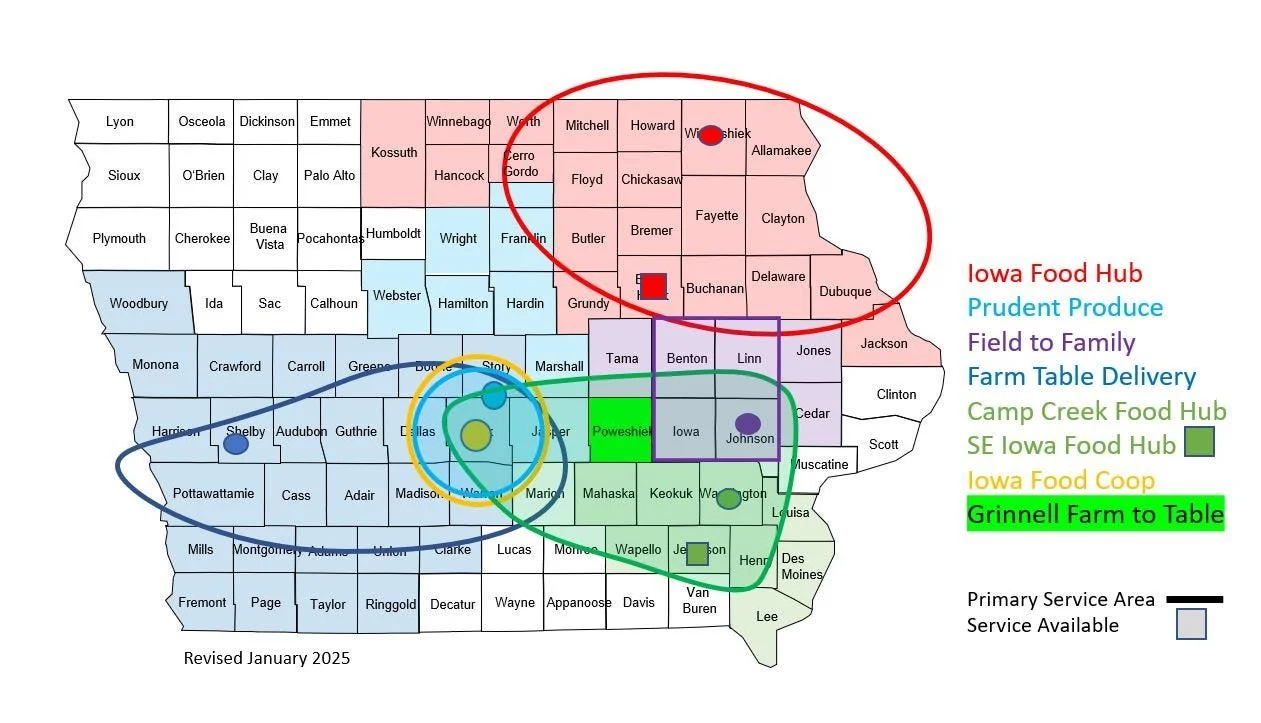
Iowa’s Food Hub network, serving nearly 70% of Iowa counties, exists to help producers satisfy local and regional wholesale, retail, and institutional demand.
Source: Teresa Wiemerslage, Iowa State University Extension and Outreach. Last revised January 2025.
