
Food Policy Councils in Iowa
What are food policy councils and why do they matter?
Local food policy councils, sometimes called local food coalitions, work at the county, city, or regional level to strengthen Iowa’s food system from the ground up.
They bring together farmers, schools, food access organizations, public health partners, local officials, food businesses, nonprofits, and residents to identify barriers, shape practical solutions, and inform local policy.
IFSC works at the statewide “grasstops” level to connect partners, analyze policy opportunities, and advance shared priorities. Local councils provide the grassroots leadership and community insight needed to make those priorities real.
Together, grassroots councils and statewide partners turn local experience into systems-level change.
-
Food policy councils may work on school food procurement, food access, zoning, farmers markets, rural grocery support, food infrastructure, public investment, land use, and community planning. Their work depends on the specific needs and priorities of the community they serve.
-
Food policy councils can be organized in different ways. Some are connected to city or county government, some are housed within nonprofit organizations, and others operate as volunteer-led coalitions or cross-sector working groups. What they share is a commitment to improving the local food system through collaboration.
-
The Iowa Food System Coalition works at the statewide “grasstops” level to connect partners, analyze policy opportunities, and advance shared priorities. Local food policy councils provide the grassroots leadership and community insight needed to make those priorities real in communities across Iowa.
Map: Local food policy councils and coalitions active across Iowa (IFSC, 2026).
Case Study: Cultivating change in the food system through Johnson County’s Food Policy Council
The Johnson County Food Policy Council shows how a local council can move from community conversations to concrete policy, investment, infrastructure, and public engagement. Its work offers one example of how grassroots food system leadership can shape local decision-making and contribute to broader change across Iowa.
How the Johnson County Food Policy Council began:
Growing out of a regional effort to strengthen the local food system, a local food task force was established in 2007 in Johnson County, Iowa. In 2012, the Johnson County Board of Supervisors expanded the effort to create the Food Policy Council (FPC). The FPC is an advisory body to support a stronger, more connected local food economy through collaboration, research, and policy guidance.
The FPC is made up of volunteer members who represent a variety of backgrounds, including farmers, food business owners, nonprofit representatives, academics, and economic development professionals, and is supported by two Johnson County Local Foods staff members.
“When you look at the whole food system in Johnson County, the FPC is not the only piece of the puzzle,” said Madeline McCabe, Johnson County Local Foods Assistant. “There is a bigger network of people making so much great work happen, keeping everyone excited about it.”
What the council works on:
Using surveys and feedback from public forums, the Johnson County FPC continues to identify challenges and opportunities to serve all communities better.
Engage rural communities
Address rural food access and rural grocery store closures
Utilize local data
Increase storytelling
Policy wins and public investment:
The Council does more than influence policy. They also focus on public investments, public infrastructure, and community building.
Policy change: Recent policy wins by the FPC include ensuring local food and agricultural goals were included in the Johnson County Comprehensive Plan, creating an agritourism zoning district, and establishing an agricultural exemption for farms under 40 acres.
Public investment: Public investments from the Johnson County Board of Supervisors, community members, and federal and private grant programs are all critical for its success. The funding makes the Johnson County Historic Poor Farm available as a public good and agricultural educational space.
Public infrastructure: Infrastructure is necessary to strengthen the local food economy. There is ongoing work to develop a commercial kitchen at the Johnson County Historic Poor Farm for local food entrepreneurs.
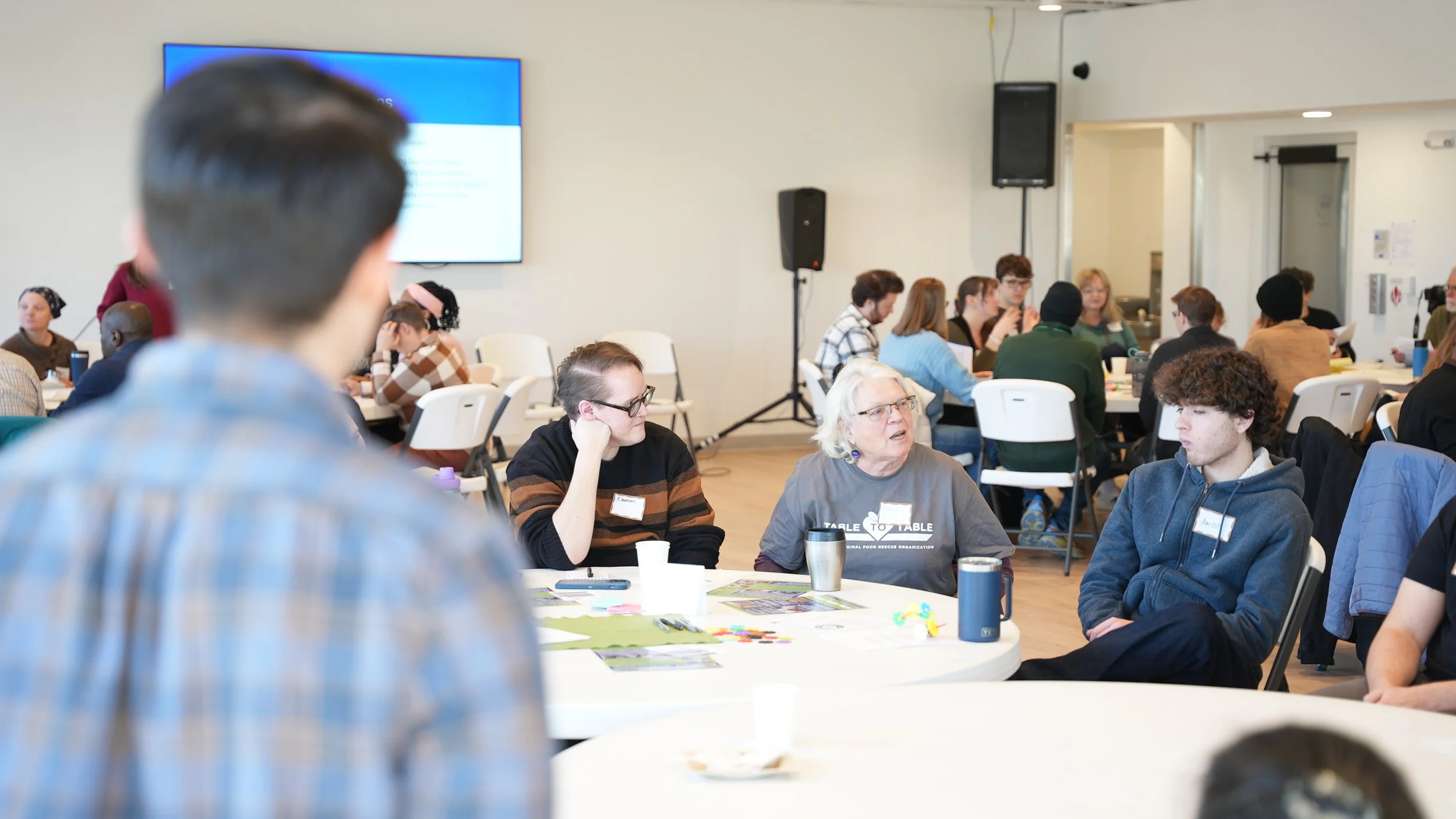
Community building: From formal events to community gatherings, the FPC is dedicated to creating opportunities for connections across the local food system. The FPC hosts two public forums each year, bringing together a wide array of stakeholders to dive into annual planning and long-term goal development.
“One of the council’s greatest contributions has been serving as a connector within the local food system,” said McCabe. “I love seeing people come together who wouldn’t have connected otherwise.”
Challenges
FPC work does not come without challenges. Shifting grant funding availability, staffing changes within partner organizations, and limited capacity all require FPC members to constantly strategize and adapt their work.
Recent Successes
Interest in the council is growing, with new members joining and increasing involvement from younger community members. Applications to be a 2026 FPC member came in at record numbers, and the group currently sits at its capacity of 15 members.
Between 2023 and 2024, the FPC offered the Community Food and Farm Grant Program (CFFGP) to small food and farm businesses at multiple stages of development. Approximately $740,000 was distributed to 41 businesses using funding from the American Rescue Plan Act.
The FPC also utilized funding from Thriving Communities, an independent organization that works to build community capacity through film. In partnership with a local movie theater, the FPC created and hosted a viewing session of short films highlighting CFFGP recipients. Drawing over 125 attendees, the screening was followed by a panel discussion and a meal from the businesses supported by the CFFGP.
Through collaboration, investment, and storytelling, the Johnson County Food Policy Council continues to bring people together to strengthen and cultivate the local food system.

“One of the council’s greatest contributions has been serving as a connector within the local food system”
Madeline McCabe, Local Food Assistant at Johnson County
In southwest Iowa, the Cass County Local Food Policy Council (CCLFPC) has been supporting the local food system for over 17 years. The Cass County Cultivators (CCC) originally organized the work, aiming to assess the current network of local food and farm businesses. CCC worked to bring together producers, residents, and organizations that played a role in the local food system. Their findings inspired the Board of Supervisors to create the CCLFPC in 2008.
The CCLFPC is funded by, and reports to, the Cass County Board of Supervisors. The members of the group include producers, consumers, and nonprofit staff.
GOALS
The following big picture goals are driven by local community input and are intended to be measurable:
Expand food access programs
Support local markets
Increase local awareness around local food
Maintain and build on past successes
PRIORITIES
The CCLFPC serves as a resource for Cass County residents, producers, businesses, and other stakeholders. Their top two priorities are improving food access and supporting local producers. The group facilitates partnerships with local and regional organizations to strengthen connections across the food system.
“Our greatest contribution to the community is getting people talking about, and connected to, local food and food resources,” said Kate Olson, Iowa State University Extension and Outreach Cass County Director. “We are proud to work with both local farmers and local buyers, including the schools, to bridge community connections.”
The CCLFPC is a key piece in networking between food, health, and agriculture throughout the county and region, while uplifting other local food system initiatives and community partnerships.
CHALLENGES
Funded through the local option sales tax, the CCLFPC's annual budget can be limited. Although an important investment, the financial limitations can be a challenge. Limited people-power and time constraints can also create obstacles, as many of the CCLFPC members are involved in several other organizations.
Successes
Having nearly two decades of work under their belt, the CCLFPC’s work has seen success in many areas.
In 2011, the CCLFPC helped establish the Produce in the Park program, a farmer’s market showcasing local foods in Atlantic, Iowa. Produce in the Park started as a monthly partnership with the Atlantic Chamber of Commerce, but it has grown into a weekly stand-alone event involving many partner organizations and volunteers.
As community connectors, CCLFPC members also pride themselves on the wide array of activities for networking and learning. They have hosted producer listening sessions to share relevant information and maintain an active community Facebook group for sharing food resources.
“My favorite memory was partnering with a local egg producer who needed a market during the COVID shutdown,” said Olson. “For a farmer who typically sells their eggs into restaurants, we were able to quickly pivot, coordinate, and assist with egg giveaways across the county to support them.”
By strengthening relationships between producers, consumers, and community partners, the CCLFPC continues to build a more connected local food system. Their ongoing efforts truly embody the mission of strengthening local food connections across Cass County.
Case Study: Strengthening local food connections: The Cass County Local Food Policy Council
