How Do We Talk About The Food System?
Talking about the food system involves terms that are not understood widely. We are providing definitions we refer to as we have developed the Iowa Food System Plan, Setting the Table for All Iowans. We know our collective vocabulary will change and grow the deeper we reach into this work so expect this to be updated periodically. Coalition refers to the Iowa Food System Coalition.
Understanding Iowa’s Food System
-
Food system - Used to refer to the system, processes, and relationships necessary to support Iowa-based producers, raising edible, table products for markets within and beyond Iowa. Food systems comprise interrelated processes that include various social, political, environmental, economic and health interactions and outcomes, impacting diverse sets of individuals, businesses, and communities.(Source: Using Networks to Build Collaborative and Equitable Food Systems, Rich Pirog, Marcus Coleman, May 2023).
-
The Iowa Food System Coalition recognizes several different interpretations of “local food”. While distance between farmer and consumer is core to the definition, local food is closely associated with the food value chain concept which emphasizes transparency, working together, and providing fair returns to all partners under shared environmental or social values. (see Food Value Chain definition)
“... desired [food system] outcomes are numerous, and no single definition can adequately capture the diverse demands that are reflected by support for local foods. Connecting demands of food system performance to the characteristics that can satisfy those demands is key to understanding the different definitions of local foods.” (USDA National Library, 2010)
Here are three definitions of local food
USDA - A food product that is raised, produced, aggregated, stored, processed, and distributed in the locality or region in which the final product is marketed. No official national designation, though some individual USDA programs use a broad (maximum) definition: Less than 400 miles from the origin of the product, or within the State in which the product is produced. Includes both direct-to-consumer sales AND intermediated sales by distributors/food hubs to restaurants, grocery stores, schools/universities, hospitals, et. al. (USDA, Why Local Food Matters).
Iowa Local Food for Schools - Modifies USDA’s 400 mile measure to “the primary farm or food business address must be in Iowa or a bordering county” (Wiemerslage, 2023).
Choose Iowa marketing campaign - local means food, beverages and other agricultural products that are grown, raised or made within Iowa (IDALS, 2023).
-
Local & Regional food system - A system that focuses on processes related to food that is grown and marketed within a defined geographic area. Markets may include direct to consumer, institutional, and may be community based, within Iowa, or interstate to reach a larger consumer base.
According to Kathryn Z. Ruhf & Kate Clancy, September 2022, in A Regional Imperative: the Case for Regional Food Systems:
“...‘local’ and ‘regional’ are not the same and conflating or confusing the terms prevents analysts and advocates from touting ‘local’ on its own merits, and from making the case for ‘regional’ food systems as strong as it could be.
“In food systems, ‘regional’ is larger geographically than ‘local,’ and also larger in terms of functions: volume, variety, supply chains, markets, food needs, land use, governance, and policy. A regional food system operates at various scales and geographies toward greater self-reliance.”
-
Food sovereignty - the right of peoples to healthy and culturally appropriate food produced through ecologically sound and sustainable methods, and their right to define their own food and agriculture systems. It puts the aspirations and needs of those who produce, distribute and consume food at the heart of food systems and policies rather than the demands of markets and corporations. (US Food Sovereignty Alliance, 2023).
-
Systems change comes about through confronting root causes of issues (rather than symptoms) by transforming structures, customs, mindsets, power dynamics, and policies, by strengthening collective power through the active collaboration of diverse people and organizations. This collaboration is rooted in shared goals to achieve lasting improvement to solve social problems at a local, national and global level. (Source: Catalyst 2030)
-
Stewardship involves caring for something responsibly. Caring for the land is inherently part of protecting ecosystems, which also include plants, animals, water, and people. Farmers and food producers manage the land on which our food is grown and thus have a direct impact on ecosystems.
Farms, Markets & Food Infrastructure
-
Food hub (Source: USDA definition): A centrally located facility with a business management structure facilitating the aggregation, storage, processing, distribution, and/or marketing of locally/regionally produced food products.
In Iowa, food hubs help connect farms with schools, grocery stores, restaurants, hospitals, food banks, and other larger buyers that may not be able to work directly with dozens of individual farms. Food hubs can help farmers access new markets, including wholesale markets, while supporting more efficient aggregation, packing, marketing, delivery logistics, and production coordination.
Food hubs often operate on slim margins while balancing complex logistics, fair farmer pricing, food safety requirements, and institutional purchasing needs. They are an important part of Iowa’s local and regional food system infrastructure because they help make local purchasing more feasible at scale.
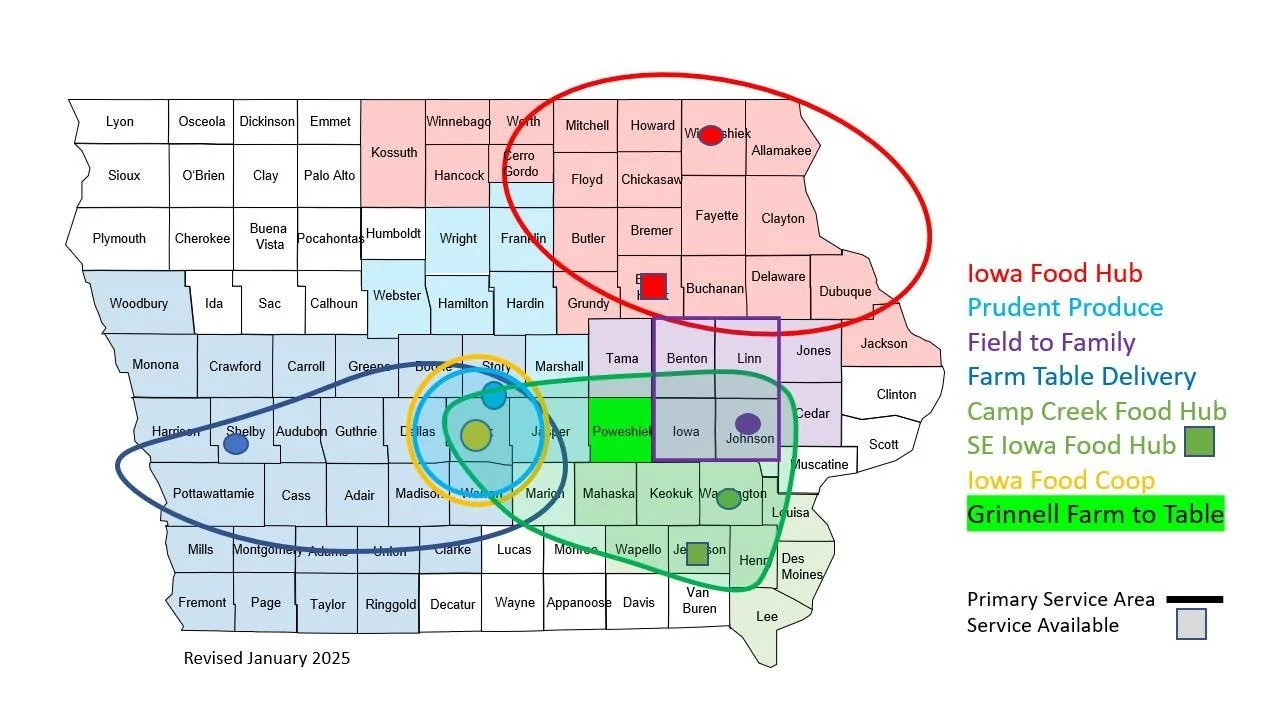
What makes Iowa somewhat unique is the level of collaboration between food hubs across the state. The Iowa Food Hub Managers Working Group regularly work together to improve technical knowledge of aggregation and distribution systems, source more local products, leverage funding, build partnerships, and grow opportunities for farmers.
These relationships have helped support collaborative statewide efforts including:
Iowa Local Food for Schools (LFS)
Iowa Local Food Purchasing Assistance Program (LFPA)
-
Food Value Chain - A values-based supply chain or food value chain is defined as a strategic alliance between farmers or ranchers and other supply-chain partners that deal in significant volumes of high-quality, differentiated food products that distributes rewards equitably across the chain (USDA AMS). Transparency, working together, and providing fair returns to all partners under shared environmental or social values are hallmarks of food value chains.
-
Value Chain Coordinator - Food value chains differ from typical food supply chains in that they are intentionally structured to produce both business success and social benefit. Value chain coordinators may play multiple roles in the development of food value chains, including: market match making, convener/relationship builder, resource prospector, policy thought leader, technical assistance provider, catalyst/innovator. (Source: FoodLinC)
Excellent resource on Value Chain Coordinator (Source: Wallace Center at Winrock International)
-
Community food web - Food supply chains that are networked, incorporating the entire food related ecosystem and infrastructure needed to grow, process, and distribute the food. Community food webs take into consideration healthy soils and effective systems that give everyone, from farmer to food system workers, viable ways to make a living (The Land Stewardship Project, 2023). The “food web” concept incorporates all the different food system clusters in a locality or region. The food web concept expands business planning to include the entire food system.
-
Community based circular food system economy - An economic model guided by core principles that keep resources in a regenerative cycle. This model draws upon regenerative agriculture practices, improving the health of both the production process and ultimately the food, and maximizing the use of the food that is produced. (Ellen MacArthur Foundation, n.d.).
Food Access, Nutrition & Community Health
-
Food security is defined by the USDA as having access to enough food for an active, healthy life at all times. At a minimum, food security includes:
readily available nutritionally adequate and safe foods, and
the ability to acquire those foods in a socially acceptable way.
Food security is often discussed in terms of affordability and access, but it is also closely connected to transportation, geographic location, health outcomes, local food availability, wages, and community infrastructure.
-
Nutrition security is defined by the USDA as all Americans having consistent access to the safe, healthy and affordable foods essential to optimal health and well-being. Nutrition security builds on food security by focusing on how the quality of our diets can help reduce diet-related diseases. It also emphasizes equity in tackling long-standing health disparities.
While food security focuses on having enough food, nutrition security recognizes that the nutritional quality of food also matters for long-term health outcomes and community well-being.
-
Farm to Food Assistance - Emergency food relief organizations like the food banks and food pantries all across Iowa play a key role in feeding Iowans facing food insecurity. In recent years, a new term - Farm to Food Assistance has emerged that approaches food assistance through food system development, shifting the narrative to recognize that local food supports nutritious diets, stimulates regional economies, sustains healthy environments and creates strong social connections.
Increasing local production, processing and distribution and investing in affordable access to nutritious local food can alleviate hunger while building a resilient and equitable food system. (Closing the Hunger Gap with Local Food).
Programs like the Iowa Local Food Purchasing Assistance Program (LFPA) demonstrate what’s possible in Iowa when this concept is put into action, connecting Iowa farmers and food producers with food banks and food access organizations across the state.
-
Health disparity is defined by Healthy People 2020 as a particular type of health difference that is closely linked with social, economic and/or environmental disadvantage.
Health disparities adversely affect groups of people who have systematically experienced greater obstacles to health based on their racial or ethnic group; religion; socioeconomic status; gender; age; mental health; cognitive, sensory or physical disability; sexual orientation or gender identity; geographic location; or other characteristics historically linked to discrimination or exclusion.
Health disparities are often shaped by broader systems and conditions, including access to nutritious food, healthcare, transportation, housing, economic opportunity, and environmental quality.
-
Food access refers to a person or community’s ability to reliably obtain affordable, nutritious, culturally relevant, and safe food.
Food access is influenced by many factors, including income, transportation, physical mobility, geographic location, grocery store availability, food prices, internet access, and community infrastructure. In Iowa, food access challenges can look different in urban, suburban, and rural communities.
Food access is closely connected to food security, nutrition security, public health, and local food system development.
Equity, Representation & Community Power
-
Equity - from the research and advocacy organization Urban Strategies Council: Equity is fairness and justice achieved through systematically assessing disparities in opportunities, outcomes, and representation and redressing those disparities through targeted actions.
The Coalition recognizes that strengthening Iowa’s food system requires addressing disparities in access, opportunity, representation, resources, and decision-making power across the food system.
-
5 points of centering equity in collective impact:
Ground the work in data and context, and target solutions.
Focus on systems change, in addition to programs and services.
Shift power within the collaborative.
Listen to and act with the community.
Build equity leadership and accountability.
(Source: Collective Impact Forum)
These principles help guide how the Coalition approaches collaboration, planning, leadership, and systems change work across Iowa’s food system.
-
BIPOC stands for Black, Indigenous, and people of color. Pronounced “bye-pock,” this is a term specific to the United States, intended to center the experiences of Black and Indigenous groups and demonstrate solidarity between communities of color.
While all people of color have been marginalized by white supremacy, Black and Indigenous communities have been particularly abused through slavery and genocide. The term People of Color has a tendency to group all non-white communities together as if they share the same experiences, thus erasing the particular trauma that has been done to Black and Indigenous communities.
-
LGBTQ+ is an abbreviation for lesbian, gay, bisexual, trans, queer, two-spirit, intersex, asexual and other gender identities and sexual orientations. It is an acronym with a "+" sign to stand for all of the other identities not encompassed in the short acronym.
-
Historically and socially disadvantaged farmers are farmers or ranchers who have been subjected to racial or ethnic prejudices because of their identity as a member of a group without regard to their individual qualities. Those groups include African Americans, American Indians or Alaskan natives, Hispanics, and Asians or Pacific Islanders. (USDA, 2018)
As a part of the Local Food Purchasing Assistance (LFPA) program, groups of historically and systemically underestimated producer groups are referred to as “Tier I Producers”. Producers self-identify during registration as having one or more of the following identities: Black, Indigenous, Person of Color (BIPOC), LGBTQ+, Women, Immigrant or Refugee, or Veteran.” (Iowa LFPA, 2023)
-
Labor Equity - Full and equitable access to employment opportunities, benefits, and resources for all people working in the various food system sectors.
Labor equity recognizes that food systems depend on workers across farming, processing, distribution, food service, retail, transportation, healthcare, education, and food assistance systems.
Land, Farming & Agricultural Systems
-
Farm - Any place from which $1,000 or more of agricultural products were produced and sold, or normally would have been sold, during the year. (Source: USDA NASS, 2022)
Federal definitions of a farm can include a wide range of operations, from small direct-to-consumer farms to large commodity operations. Iowa’s food system includes farms of many different sizes, production models, and market types.
-
Land tenure is the relationship that individuals and groups hold with respect to land and land-based resources, such as trees, minerals, pastures, and water.
Land tenure rules define the ways in which property rights to land are allocated, transferred, used, or managed in a particular society (Landlinks). Land tenure shapes many farm decisions, including those related to production, conservation, and succession planning (USDA Economic Research Service).
Land tenure can influence whether farmers are able to access land, make long-term investments, adopt conservation practices, or transition farms to future generations.
-
Land Trust - a community-based, nonprofit organization that actively works to permanently conserve land. (Land Trust Alliance)
Some land trusts focus on farmland protection, helping preserve agricultural land for future food production, conservation, and community benefit.
-
Zoning is a regulatory tool that local governments can use to control what is allowed on an area of land within the city.
Separating land into zones prevents nuisances and allows local governments to have more control when regulating different types of land use. Most zoning takes place at the city or town level, but county or regional laws may also regulate some of the same uses. (Healthy Food Policy Project).
Zoning policies can shape food access, urban agriculture, food businesses, farmers markets, processing facilities, housing, transportation, and other parts of the food system.
-
According to the USDA NASS 2020 Local Food Marketing Practices Survey, farms may sell into several different types of markets within the food system.
Consumers - Includes sales through farmers markets, onsite farm stores, roadside stands, Community Supported Agriculture arrangements, online sales, pick-your-own operations, mobile markets, and other means.
Retailers - Includes supermarkets, supercenters, restaurants, caterers, independent grocery stores, and food cooperatives.
Institutions - Includes schools, colleges, universities, and hospitals.
Intermediate markets - Includes intermediary businesses such as wholesalers, distributors, processors and more.
These different market types help shape how food moves through Iowa’s local and regional food system.
Coalition Planning & Collective Impact
-
Collective Impact - The framework the Coalition uses to guide development of Plan goals and action strategies.
Collective impact is a collaborative approach that brings organizations and community partners together around a shared vision and coordinated action. The Coalition uses this framework to help align efforts across Iowa’s food system.
-
Common agenda - collectively define the problem and create a shared vision to solve it.
A common agenda helps organizations and partners align around shared priorities, goals, and long-term systems change strategies.
-
Shared measures - Tracking progress in the same way, allowing for continuous learning and accountability.
Shared measurement helps Coalition partners evaluate progress, identify gaps, improve coordination, and better understand how collective efforts are impacting Iowa’s food system over time.
-
Mutually reinforcing activities - Integrating participants’ many different activities to maximize the end result.
Rather than all organizations doing the same work, collective impact encourages partners to contribute different strengths and expertise toward shared goals.
-
Continuous communication - Building trust and strengthening relationships.
Strong communication helps maintain alignment, transparency, accountability, and collaboration across diverse organizations and communities working within Iowa’s food system.
-
Strong backbone - A team dedicated to aligning and coordinating the work of the group.
Backbone support organizations often help coordinate communication, facilitation, planning, data collection, project management, and relationship-building across collaborative initiatives.
-
The Iowa Food System Plan, Setting the Table for All Iowans, launched in 2024 and was guided by shared vision, values, and identified high priorities, grounded on a commitment to racial equity, and evaluated through shared measurement.
The priorities are developed into Goals, Strategies, Specific action plans, and supported by Priority Teams.
-
Priorities - of the many issues rooted in Iowa’s food system, the Coalition has identified the top issues to achieve the change outlined in our vision and values.
These priorities help guide coalition strategy, partner collaboration, policy development, communications, and systems change efforts.
-
Strategic Actions - specific actions that inform how Coalition leaders will address identified priorities. These actions are backed with shared measures and an agreed upon timeline/plan of work.
Strategic actions help move broad food system goals into measurable and coordinated implementation efforts across the Coalition and its partners.
-
Partner - The Iowa Food System Coalition is made up of partner organizations, institutions, businesses, agencies, and individuals working together to strengthen Iowa’s food system.
Coalition partners represent many different parts of the food system, including farming, food access, public health, education, conservation, economic development, food businesses, policy, research, and community development.
Rather than functioning as a single organization delivering programs alone, the Coalition works through collaboration, coordination, shared strategy, and collective action across its statewide network of partners.
Partners may participate in Priority Teams, working groups, policy efforts, events, communications, research, or collaborative projects connected to the Iowa Food System Plan.